The Fundamentals of AI Transformation (That Most Organizations Are Getting Wrong)
Welcome to the Purposeful AI blog! Our aim is to bring a practical approach to adopting AI within your unique context to help you avoid the common blindspots and sidestep pitfalls. We’re co-authors Dr. Shahzia Holtom and Martina Hodges-Schell. We’re partnering up to write a book to share our hard-earned lessons and observations from decades of experience as AI and Product experts driving transformations at scale. If you’re a CEO, CTO, or anyone else looking to tap into AI’s transformative properties in a purposeful way, we invite you to follow along here or join our group on LinkedIn for all the latest updates on our research and the book’s progress.
We can usually sense when a new invention has the possibility to change the world. But we’re not always able to predict exactly how.
There’s a great example of this in scientific lore. When Michael Faraday presented his work on electromagnetism, a politician asked him, “What good is it?” Faraday responded by quipping, “What good is a newborn baby?”
Faraday’s point was that we don’t necessarily know how technology will evolve and what it will eventually be capable of. But we can still understand that it’s full of world-changing possibilities.
We’re at a similar inflection point with AI. We know that there’s infinite potential, but we’re still in the infancy of its application to business problems.
Laying the foundation: What direction are you setting?
Most organisations are experimenting with what AI can do for them. Much of this experimentation is organic with a ‘Let’s see what we can do’ approach. But scaling past this point requires more thought. As a CEO or CTO, you’re in a position to guide this experimentation, to shape the direction it takes your organisation in. And it all begins with the questions you’re asking.
While the early experimentation is focussed on “How can AI help us do our jobs better?”, the question that’s often overlooked is “How could AI help us create net new value?”
These two questions represent two different paths:
Optimisation: How can we do existing work faster or cheaper?
Value creation: What new problems can we solve - which are only now possible?
This shouldn’t be an either/or proposition: You can and should encourage your team to look for ways to accelerate their work or reduce the time they spend on low-value tasks. The key is not to stop there. The real opportunity for AI transformation comes when you take the value creation approach. But these aren’t the only two options. In the next section, we’ll take a look at a common progression we’ve seen with AI transformation efforts.
The altitude framework: What’s your ambition?
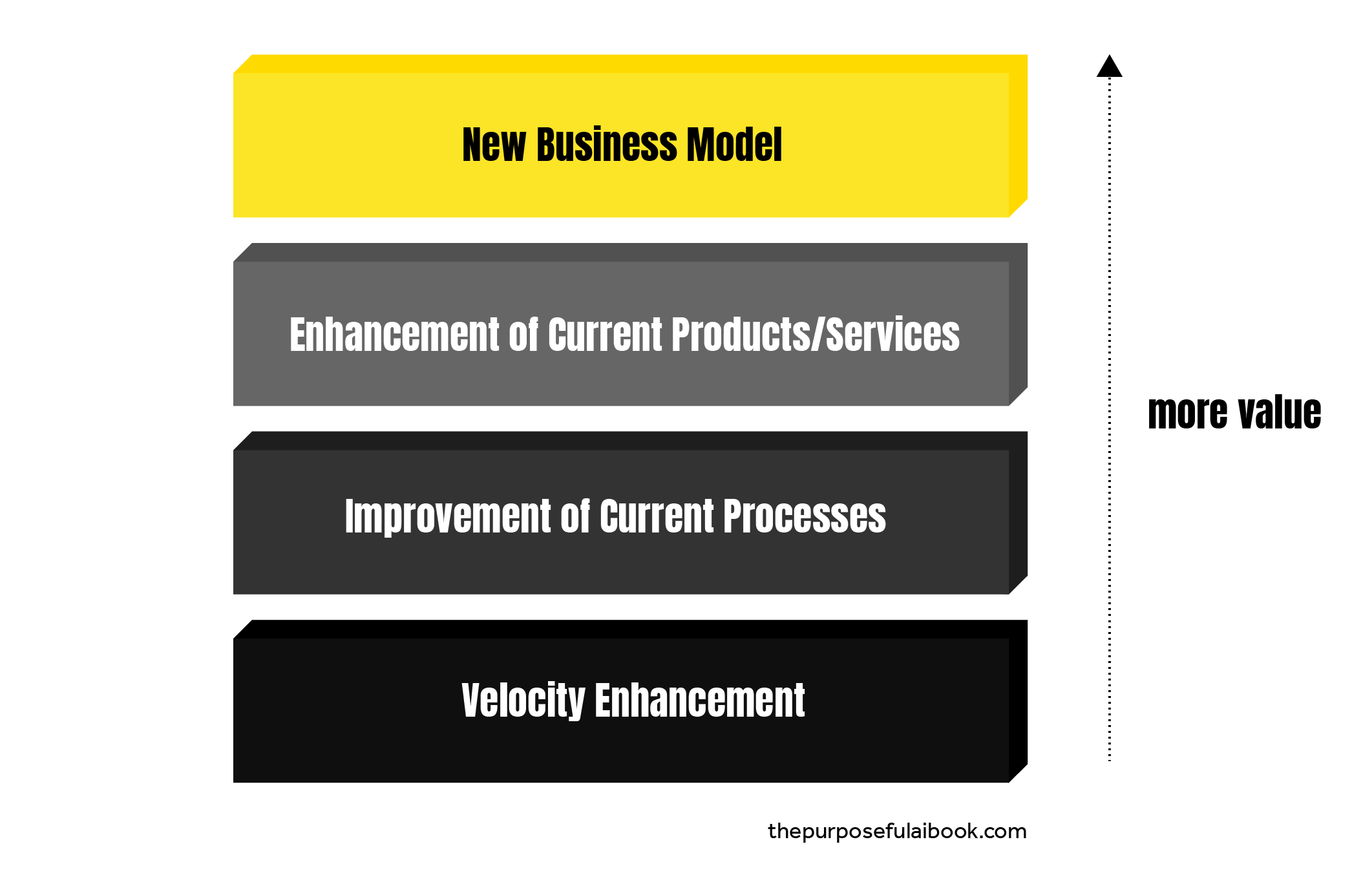
AI adoption within your organisation can be mapped to different altitudes or levels. The bottom levels involve less uncertainty and investment—but they also have smaller potential for impact. The higher levels have greater uncertainty and investment associated with them, but they also have the most potential for creating value.
| Goal | Potential |
|---|---|
| New business model | More uncertainty and requires more investment, but also has the most value potential |
| Enhancement of current products/services and offering AI features | Innovation potential within the confines of current value propositions to the customer |
| Rethinking and Redesigning current processes with AI | How does AI change the workflow, not just speed it up? |
| Velocity enhancement to parts of your workflow without major changes to the workflow itself | Less risk, smaller investment, but smaller value potential. Often leads to patchy application of AI tools. |
One way of looking at AI transformation is like learning to cook. There’s a wide gap between someone who can just follow a recipe and a Michelin chef whose knowledge and training allows them to prepare a comprehensive and well-balanced tasting menu customised to the unique local context. Our aim is to help you learn to cook with practical steps and blueprints.
How do you know if you’re ready?
Take our simple innovation maturity self-assessment, which you’ll find below. As a leader who sets the direction for your organisation, your goal should be to help your teams move up the levels so they can eventually focus their efforts on value creation. But it’s not as simple as just telling them to go find new problems to solve. You need to first ensure that your teams have the appropriate skills and support to do this effectively.
Go through the questions below to see how many apply to your organisation today. Use your gut feel (and follow up with a reality check) to score your organisation on a scale of 1 (low/rarely) to 5 (high/very frequently). Score 0 for not at all.
How often do your teams run experiments?
How lean is your team’s approach to modernising code/building new products/features?
How often do your teams go from idea to adoption success with measurable metrics (not just to production and hypothesiszed impact)?
How well does your team understand what's important to the business?
Can you truly step into your end users' shoes?
When does your team get involved in developing new products and services?
If your total score is between 6–18, your ability to innovate today is low. Build your organisational muscle in these areas to develop a higher maturity for innovation.
If you're not sure how to do this, we'll be sharing case studies and insights in the coming months, so stay tuned!
A few guiding principles to keep in mind
No matter which level you’re at today, there are a few guiding principles we recommend you keep in mind.
Define your non-negotiable metric
Start by defining your non-negotiable metric, such as customer retention. This will help you know if you’re succeeding and provide framing for any experimentation you do. It will also reduce the likelihood that you’ll fall prey to Hutber’s Law, which is the belief that most so-called improvement is actually a form of deterioration. If your proposed changes have a negative impact on your non-negotiable metric, you’ll know you’re starting to veer off course.
Create the right conditions
It might sound obvious, but you need to create a culture that supports exploration. If your team members aren’t able to experiment, fail, and make adjustments along the way, there’s no way you’ll be able to reach those higher levels of innovation and value creation. Look for ways you can cast your net wider to discover opportunities, identify the main uncertainties, and develop learning goals and interventions to learn quickly. Check whether leadership behaviour and expectations support or block teams here.
Plan for scale
Don’t expect total transformation in one single step. If you want to scale beyond point solutions, you need DNA-level changes. This means you’ll need to transform everything from your culture and infrastructure to the people themselves. It might involve starting with a pilot team or project and then applying those lessons more broadly to other teams. The willingness of your organisation’s senior leadership team to list, act, and remove barriers for your team is critical to the success.
There are only two options on the table
This is not a “wait and see” situation—there’s no question that this technology is a value multiplier for every organisation.
For leaders, there are really only two options on the table: You can either discover the next value creation opportunity yourself and be the first to market, or you can build the muscles so that when your competitor discovers it, you’ll be able to catch up. And remember—you can’t change culture, people, and processes overnight. If you haven’t laid the groundwork now, you won't have the ability to adapt when you really need to.
Don’t miss our latest insights and book updates—join our group on LinkedIn to stay in the loop, gain access to our early readers’ club, and more.